Wednesday, 25 July 2012

Reviews Of Books I Have Not Read

The Selected Poems of Wallace Stevens
I found this book on the free shelf of my local community center and it's no wonder someone gave it away when presented with this author's photo on the cover. With a mug like this who wouldn't give you away. Except your mother maybe. Nevertheless, here is Wallace Stevens in all his latter year glory, finally come into fruition like a rotting pear on a Sunday morning, as the full-blown renowned poet whose enigmatic work could, in the words of Stevens scholar, Prof. Phil Runts, of Nibster's Community College of Omaha, from his essay, "Bird Songs and Droppings in the Poems of Wallace Stevens,""make a nightingale sing loud enough to erase all traces of Maurice Chevalier."
Let it be said that the photo of the author adorning the cover of this volume shows a smartly dressed but dour man and the image does not betray the reality. For dour he was, toiling away for years at the Mutual of Omaha head office, upset that he didn't get the role of host on Mutual of Omaha's Wild Kingdom and instead was left at a desk adjusting insurance premiums while Marlin Perkins got to cavort with very personable chimps and all manner of wildlife he encountered on safari. Meanwhile, Stevens lived a dullard's life and, ironically, it was this routine that was the impetus for him becoming the great poet that we remember today. His words took us to places we'd never been, nor had he for that matter, holed up in Nebraska most of the time except for the odd occasion when he traveled out of state with his bowling team. They were the mid-west bowling champions of 1964, eliminating Moe's Milwaukee Marauders in a nail-biter that required a recounting of every frame. Stevens composed an epic ode to the event, "Gutter Ball of Bathsheba." Here's the first stanza.

Gutter ball screamed the parakeet;
How often its disgusting little feet gripped the
glint of false light
of morning,
heroics left to the shadows of
naked dwarfs bulging with
the rocking of ramshackle clouds
after the railroad train
pulls out of Peking
and the creamery shutters
bang in the piebald heat.

One might say this stanza is exemplary of Stevens' poetry. Personal and yet detached, the embracing of the everyday but in abstract thought, contemporary and yet classic, all contextualized with an underlying sense of revulsion for life that makes one think Stevens must have thrown up after finishing each line. In fact, the Smithsonian has, in its archives, some vomit splatters attributed to Stevens on Mutual of Omaha letterhead paper upon which were the jottings of an early poem, The Bananas of Doctor Horst. This poem is famous amongst lovers of Stevens' poetry because it documents his first foray into cosmopolitan life after a rare visit to New York to see a highly recommended podiatrist for his severely fallen arches. Is he the Dr. Horst to whom Stevens alludes? And what is the connection between podiatry and bananas. The poem vaguely answers this in Stanza Six although Doctor Horst still remains a bit of a mystery as does his relationship with bananas. Doubt me? Read this!  

Back at the Waldorf
The world hummed in his handkerchief,
Naked tragedy clawing at the tunky-tunky-tunky
planks of bananas, masculine and feminine crowded like poodles under parasols.
Oh, mother, do not enter the foliage
where paratroopers with unhealthy appetites
bear barren fruit of bleak illusion,
and an old man on a mountain is only the anatomy left of tragic puppet spray.
Plinky, plinky, plonk, piano keys of loquacious salad beds,
never were the sounds so unsmelled
than in the labial gardens of Dr. Horst and his bananas,
the arches of Minneapolis fallen in the savage debris of disillusionment.

The great sweep of Stevens' philosophical questioning, his charm and wit and irony are all as evident in this piece as the melanoma moles upon his face and his stoicism is surprisingly derailed by an underlying fecundity as lusty as overripe breadfruit that hang like the well-suckled breasts of a mother of sixteen (Stevens had sixteen siblings and so this simile is not so far off the mark of Stevens' impressions of his own mother's breasts, especially since he was the last born and those breasts were ready to fall from the tree, in a manner of speaking, by the time he got his little lips around their life-giving, albeit, somewhat hairy and saliva-eroded nipples). On the subject of his mother, Clutchy, Stevens' love of her was so great that in later life he sought a marriage partner who could have been his mother's doppelganger. Thus his betrothal to Tilly Svenson, a loathsome girl from his old neighbourhood where he grew up, who blossomed into a loathsome woman with strong-as-an-ox buttocks from her obsessive-compulsive butter-churning disorder and a fetching smile that many storekeepers and trolley car operators always said could've landed Tilly in the moving pictures industry if she'd only stop carrying her butter-churning bucket clutched to her hefty bosom, was a marriage made in heaven from Stevens' perspective. Her cool, Nordic blood turned out to be a good match for Stevens' deeply buried lusty urges, which he was usually only able to release through alligator-wrestling.
The loathsomely fetching Tilly Svenson (on the right), seen here posing with Stevens' mother, Clutchy and his grandmother, Yeggdrasil (sitting). Three peas in a pod? You betcha and it's difficult to say, if I hadn't told you, which of these women was not born into the Stevens family, so alike are their features. It's as if Tilly Svenson could have been sprung from the very loins of either of the other two women in the picture. The photo, incidentally, was taken at Tilly's engagement party where she churned butter relentlessly while reciting ancient Nordic sagas about the death puffins that line the fjords of Bjornvalhallagoothen and carry the souls of great Viking warriors across the water to Jornsen's Furniture Outlet and Broadloom Emporium.
On the subject of reptilian roughhousing, it was Stevens' talent for alligator wrestling that he was sure was going to secure him the spot as Mutual of Omaha's Wild Kingdom host. For Stevens, wrestling alligators was like a kind of poetry in motion, so it's no great mystery that when the 'gator wrestling didn't pan out, Stevens turned from reptiles to rhyme. Still, that didn't help to lessen the blow when he wasn't given the Mutual of Omaha's Wild Kingdom host position, even after providing upper management with breathtaking photos of himself wrestling these fearsome beasts and demonstrating his own special move that would later, in 'gator wrestling circles, be dubbed the Stevens Gator-ator Sleeper Hold.
In his younger years, Wallace Stevens was a formidable alligator wrestler, a difficult pursuit when you realize Nebraska is not an alligator epicenter. It was this photo that Stevens submitted to Mutual of Omaha when they were launching their Wild Kingdom TV show, figuring the skills displayed in this image would make him a shoe-in for the host of the program. After losing out to Marlin Perkins, whose mustache Mutual of Omaha was taken with not to mention he looked better in a safari suit, Stevens turned his back on wildlife and the foliage it liked to hide in and embraced poetry in the great sorrow that was to shadow his life until he died. Hence, one must only witness the constant references to parakeets, goats, rattlesnakes and mating orangutans to understand that his initial dreams never left him, but were transferred, and, one might add, transcended, the commonplace into beautiful poetry in a voice so modern, many critics could only shake their heads in bewilderment, disbelief and occasional bouts of ptomaine poisoning.

In fact one of Stevens' most famous poems, Thirteen Ways of Looking at a Blackbird, was originally composed as Twenty-Nine Ways of Looking at and Rasslin' an Alligator, but he was convinced to change it by his friend and fellow insurance agent, Mortie Shugmeyer, who felt the alligator imagery might dissuade readers from enjoying the more lyrical passages and subtler metaphors of the piece. Amazingly, some of the original stanzas still exist on a waxed paper sandwich wrapper found in the back of Stevens' desk at the insurance office where he toiled until his death. Here's a sampling.

   I
A man and a woman and an alligator
Wear sagging pantaloons
And smell of summer fields, skeletons and meat gravy,
Their shadows traced by blotchy blackbirds with grim hallucination.

  II
I was of three minds,
The alligator, the blackbird and a discarded mouth-organ
Left on the shore of a blobby sea
Dark marine with the hems of beggar's capes,
Happy fecundity
You phantom glass-blowers of North America.

 III
Yowzah, yowzah, yowzah
O thin tailors of Vesuvius,
Your warbling is like the blindness of ground beef,
The inescapable rhythm of newspapers blown by the coughing
That brings poetry
To the pineapples of artifice.

 IV
Is that an alligator in your pants
Or do you just want to rassle me
Under the sassafras tree
Greased with the jelly of a perplexed machine.
The alligator rests but the blackbird is wary, taciturn,
A paper mache ventriloquist dead on a sofa near Lake Geneva
Knows this and remains as bitter as a dried leaf
Pressed between the pages of a nudie picture book
Begetting tubas and purple prunes of engorgement.

The above diagram illustrates the four essential steps for performing the Stevens Gator-ator Sleeper Hold that has been adopted by 'gator wrestlers from the Everglades to the Louisiana bayous. Little did Stevens know that as his poetry would gain immortality so would his famous alligator wrestling move. Circulating amongst and influencing these two cultural circles, one could say, was Stevens' greatest accomplishment, bringing poetry in all its forms to both the common man and the higher spheres of learning. Many's the time Stevens was quoted as saying, "Any poet that can't wrestle a 'gator is a poet I'll never understand."
Again, Stevens' acuity and versatility with language makes one forget that he was raised in a chicken coop as a child and until the age of ten could only scratch in the gravel with bare feet and cluck whenever pleasure or pain was visited upon his body. But if it's true that childhood provides the most formative years, one can only wonder if he wouldn't have become as erudite and philosophically far-reaching if he hadn't first lived among the chickens and gained a sense of nature and its disharmonious relationship with the growing modern world, understanding that one day chickens and insurance agents would never see eye to eye despite the fact that in the past they both pecked happily from the same overfilled trough. But then reason flies out the window with poetry, as well it should, because if you've ever tried to shove the two of them through one windowpane, well you'd end up with a lot of broken glass, splintered wood and a repair bill that would seriously deplete your beer and pickled egg fund. And yet, paradoxically, Stevens was able to meld the two realms, reason and poetry meeting on uncommon ground as his insurance acumen and poetic perspective and embodiment, right down to the socks and boxer shorts he wore, pushed the boundaries of verse and provided policy holders with something to think about when their houses burned down or their property was stolen while they were having martinis with the Lundquivsts at the tennis club. Circumstance, happenstance or just part of the cosmic dance, all questions one has to ask as it has been rumored Stevens was prone to burn down the homes of policy holders to teach them the hard lessons of poetry. There is a cruelty to his beauty and god help anyone who dismissed him, especially if there were any sharp objects or flammable materials around. And yet Stevens was not above the lighthearted and lyrical touch as evidenced so well in his famous poem, The Emperor and the Ice Cream Truck, reprinted without permission below.

Roll out the barrel,
And yell hap-hap hallow,
For the wench is but a horny-footed cataleptic polymathic hierophant vassal
Born of Mrs. Pappadopoulos.
Ice cream, ice cream, we all scream
With gawky beaks
And the emperor rubs himself
With weak facts and an old fantouche,
Lacking a personalia and a dog-eared vocabulary,
It's just booming vulgarity
In vanilla or chocolate.
So don't even ask for coconut
You lewd opiate of chastity and musty teeth.

So affix your fuzzy wig
To your swollen and knobby head,
And inhale the odors of the fantails of Oklahoma,
And then ask yourself with trembling lip and palaver of hand
what do you want, a rifle-butt or sugar cone?
Beep, beep,
Don't touch my bumper of doom
You concupiscent curd of an excuse for a human,
for I am the Emperor of the ice cream truck
and no, I don't have any pistachio.

Here is Stevens displaying the full range of his poetic maturity, or as Stevens scholar, Prof. Phil Runts of Nibster's Community College of Omaha, has put forth, it's this poem above all others that makes him itch as if he were being eaten alive by fire ants. This simile proves to be all too apt for it's this discomfort evoked by images of comfort that makes Stevens' poetry the equivalent of sleeping on an old sofa bed where the springs protrude and the mattress is stained with urine and withered cherry blossoms. Such beauty cannot be held in the hand or mouth or even kept in an old shoebox in the back of the closet with the mothballs and silverfish. It can only be felt and held in the heart except if you have a pacemaker, in which case you might need a good-sized piece of Tupperware, preferably with a properly fitting lid. Or in the case of Prof. Phil Runts, the full impact of Stevens' poetry can best be enjoyed by employing his patented Wallace Stevens Head Harness. Either way, Wallace Stevens is here to stay and if you have a problem with that, well, then, go wrestle an alligator and see if you don't get your head chewed off. Then maybe you'll understand the greatness of this man who had the soul of a poet, the heart of a reptile and a face not even a mother could love.
Pictured here is Prof. Phil Runts demonstrating his patented Stevens reading device. The volume of poems is strapped to each side of the head as Prof. Runts has discovered that the poetry is best enjoyed and deciphered using extreme peripheral vision. How he has come up with this theory remains a bit of a mystery but I have tried the device out myself and can only say am wowed by my new understanding of Stevens' work, although I did get a splitting headache and was wall-eyed for a few days.


Monday, 23 April 2012

Reviews Of Books I Have Read

The Gloxpusian Chronicles by Morton Clancy Snitzler IV
I'll guarantee this. The next time you're at an all-you-can-eat baby shrimp buffet you'll never look at these delicious creatures in the same way after reading this wonderful book of speculative fiction. Now I'm usually not one for fantasy or science-fiction but this book knocked my socks off, no mean feat when you realize my socks are so old and crusty, most nights I have difficulty peeling them off my feet. For the record, I keep my socks this way on purpose in order to cure my athlete's foot. By attiring my feet in lazy, unwashed socks I'm attempting to stifle my feet's athleticism, leading by example, so to speak, encouraging my feet to become sluggish, lethargic, almost lifeless and thus drive every element of their athletic fungus from the core of their being and the strange bit of webbing between my toes that I've been blessed with. I guess you could say it's a sentiment such as this, feeling blessed by an abnormality that makes a good segue into the heart of this novel.
The author posing with one of his detailed diagrams that helped him to better envision his creations and keep track of the many intertwining plot lines that make up his magnificent novel of the future. The diagram shows the highly advanced vacuuming device that the Gloxpusians used to suck up all the baby shrimp from the earth's oceans along with storage container-like constructions used to transport the baby shrimp back to their planet.
For the Gloxpusians, a highly-intelligent race of beings from the Frederick R. Gladstone galaxy, six hundred million light years away, are crazy for baby shrimp. How they became this way is a cause for speculation but the author hints at an abnormal biological trait and a series of stray enzymes that cannibalize their host bodies unless subdued and eventually satiated by tiny crustaceans. The enzymes go rogue speeding up the Gloxpusian metabolisms and soon all the baby shrimp in the universe are threatened. Either way, Gloxpusians crave baby shrimp, need it, yearn for it so much so that the vast quantities they consume actually alters their body chemistry, much like that of an opiate addict, until they cannot live without ingesting at least two pounds of baby shrimp per Gloxpusian a day. The author himself has admitted to a dangerous periwinkle habit and in an interview has revealed consuming up to fifty of these sea snails daily and so is not stranger to these kinds of urges or this type of subject matter.
Here's the baby shrimp in all its glory. Even if you're not a Gloxpusian what's not to like about this delicious little creature. In my younger days when I was still filling out my britches, I could eat a bucket of these crustaceans, carapace and all. And contrary to what people might tell you, there's a lot of meat in those spindly little legs but you have to suck them just right to get it out.
As the story unfolds we learn the Gloxpusians have been visiting earth for some time, quietly and discreetly pillaging our oceans of their baby shrimp bounty but as the Gloxpusian's need for this delicacy grows, soon buffets all over the world are feeling the baby shrimp depletion. First to sound the alarm is Ardolfo Hispalari, banquet manager at the famed Borshines Hotel and Casino on the Las Vegas strip. When his baby shrimp supply runs dry and he's subsequently told by his supplier that he's not even sure if he can procure any more, Ardolfo goes crazy, pulling out his mustache hairs one by one, a painful process that takes him most of the afternoon and part of the evening, so great is his reputation aligned with Borshines renowned all-you-can-eat shrimp hour that he's willing to exfoliate himself in this manner. Next, in Vargasburg, California, at the esteemed Mendel's Mollusk Barn, Mendel Johnson throws himself from the roof, breaking a wrist and losing his toupee after learning that there's no more baby shrimp for his Shrimp Gorge Festival Days. As Mr. Snitzler piles tragedy upon tragedy with the good citizens of earth trying to take their lives or at least harm themselves in unusual ways as the shrimp news hits them hard, we, the readers, feel their pain, so strong is the characterization and descriptions Mr. Snitzler conjures up in his oddly perfunctory yet almost baroque style that reminds me a lot of a young Flaubert before he had that accident where a monkey mistook his head for a coconut at the Jardin du Palais Royal, twisting and twisting at his cranium causing severe whiplash, a concussion and acting as a catalyst for post-monkey-mistaking-head-for coconut stress syndrome that forever cast a pallor upon Flaubert's future work.
Oddly enough, Flaubert befriended the monkey that mistook his head for a coconut and with no hard feelings between them, they soon became inseparable as evidenced in this photograph. They would often go out on the town, visiting the Folies Bergere or dining at Les Maggots du Morte and became such a pair in Parisian high society that Toulouse Lautrec immortalized them in a painting that hung in a brothel on La Rue Couchon, frequented by wealthy patrons, many with wooden legs, glass eyes and toupees made from the wings of bats. The monkey was also known for his impeccable dress and in later years even Coco Chanel was known to ask his advice on certain occasions and the monkey was particularly taken with her because the first four letters of her name were the same as those in the word coconut.
 As usual with novels of a genre nature, there is always one bad guy, willing to align him or herself with the invasion forces that menace society with the promise of great fortune, power, infamy, a place in history and a pick from any fish in the sea, and by fish I don't mean shrimp or fish or anything that lives underwater and eats plankton for sustenance or in the words of Mr. Snitzler, "I'm talking about a broad with luscious lips and shapely gams and bazoombas that could stop an elephant in his tracks."  In this case, the villain in cahoots with the aliens is one, Sgt. Milton Dewlap, of the Utah State Police who meets the Gloxpusians one summer night while out patrolling the desert looking for illegal ground mice. Here, things get a little convoluted in exactly how Sgt. Dewlap's role in the great Gloxpusian shrimp takeover works, especially with Utah being a landlocked state with nary a shrimp to be seen, but it all has to do with Dewlap's ability to astral project his body, only when he's wearing his magic hosiery, and in this invisible form penetrate NATO Command Defense Centers, shutting down air and ocean radar systems so that the Gloxpusians can safely descend, virtually undetected and vacuum up all our shrimp. The plot thickens when the Gloxpusians become dissatisfied with Dewlap's assistance due to a few Portuguese man-o-war incidents that I won't give away but, suffice to say, Dewlap is beamed aboard the Gloxpusian ship and given a good talking to.    
On board the Gloxpusian ship, the Gloxpusians accusing their only ally earthling, Sgt. Milton Dewlap of the Utah State Police, of not sufficiently alerting them to the dangers of the Portuguese man-o-wars they inadvertently sucked up with their supply of baby shrimp, causing many Gloxpusians to be stung into coma-like states (the Gloxpusians are far more susceptible to Portuguese man'o'war poison than human beings due to their double bladder system and over-active mitochondria).
Feeling the Gloxpusian heat, Dewlap escapes from the ship using his astral projection techniques (his astral body acting as a kind of placeholder fooling the aliens while his real body beats a hasty retreat), and back on earth goes directly to the CIA to report on the Gloxpusian shrimp cloak and dagger thievery. The CIA then enlists Dewlap as a spy to run a counter-espionage scheme, promising him immunity from prosecution for helping the Gloxpusians in the first place if he can report on all their nefarious plans and help aid the CIA in launching their own diabolical plan to counter-attack the Gloxpusian High Command.
Sgt. Milton Dewlap's astral projection technique is not some whimsical flight of fancy that one would read on some nut-pants' website, but rather founded on hard, scientific fact as demonstrated here in these revealing photos from Dr. Natasha Onklure's Institute of Phenomenonological Research, based in Beaverton, Ontario. Located kitty-corner to the Wal-Mart and right next door to Fledgling's Love Shop & Marital Aid Emporium, the Institute has been furthering investigative techniques into paranormal sciences as well as doubling as an end-of-the-roll carpet warehouse to fund its various experiments. In this series of images, Dr. Onklure, demonstrates sensory transference between the subject and his astral body using her specialized navel swabbing method and measuring responses via her patented feedback helmet and astral-vision goggles.
In this final section of the book the plot really picks up steam with all sorts of devious endeavors from both the earthling and alien parties, culminating in one of the CIA's most successful campaigns, waged with the help of state trooper Sgt. Dewlap and the U.S. Marines. Dewlap, still working undercover, notifies the Gloxpusians that there's no more shrimp in the sea but that he's found a new food source that they're sure to enjoy with equal fervor. Sweet baby chick meat is the solution and once the Gloxpusians taste this lovely and savoury delicacy, they go baby chick meat crazy and the feeding frenzy is under way. The CIA then puts its plan into full swing using bearded mannequin heads that attract the baby chicks who believe the bearded plastic heads to be their various mothers (Snitzler lays out some hard evidence as to why this natural phenomenon occurs but I remain skeptical, but nevertheless, grant him fictional license in this plot twist). In this manner, the CIA is able to attract thousands of baby chicks to various mannequin head hotspots across the country and inside each head is a surveillance camera and high explosives ready for detonation. And detonate they do, blowing Gloxpusians to smithereens as they attempt to gather the baby chicks (by hand this time as they haven't perfected a baby chick vacuuming device), the CIA watching their every move via the mannequin head surveillance cameras so that the Gloxpusian death and casualty toll is maximized. It's this kind of efficiency that makes you take heart and equally makes your heart skip a beat with pride in the secret organizations that protect our countries from purported alien species. I will not spoil the book by giving away the nail-biting finale to this amazing novel but I will say the Gloxpusians are no pushovers and when push comes to shove the Gloxpusians are more than able to give the earthlings a taste of their own exploding medicine. 

In this photo, only recently released from secret CIA files, we can see that Snitzler's baby chick/bearded mannequin head attraction equation is founded on some groundbreaking experimentation. Snitzler again demonstrates his veracity in all things scientific, grounding his work in some of the most covert exercises practiced in underground laboratories worldwide. In this example, the KGB had been experimenting with baby chicks and Bolshevik heads for what devious means only those in the know know for sure. 
Does this all seem a little too far-fetched? Well, look around you or don't look around you because you probably won't see anything anyway or if you do see something you won't know what you're really seeing, so set and mired down as you are in your earthling ways, and if you aren't and have acute eyesight, like me, I suggest you still don't look around because you won't like what you see because there are those who walk or slither among us who have combination tentacle-pincers where other people have ears or arms or knees. That's the lesson Snitzler hands down to us through this science fiction parable, a work of such expansive thought and shocking concepts that its time is perhaps too soon and yet long overdue. It's no wonder Ray Bradbury's brother-in-law, Fred Lingshorn, states, with no doubt wavering in the voice-box that is his voice (after a rabid squirrel claimed his larynx), that next to The Martian Chronicles the Gloxpusian Chronicles is the finest book of speculative fiction with the word chronicle in its title that he's ever read and he'd even go so far as to say it's the best except his brother-in-law, Ray, just bought him a new car so he's obligated to side with Mr. Bradbury, especially since Cadillacs don't grow on trees. I, for one, have not received a Cadillac from Mr. Bradbury so I have no qualms in saying this chronicle would make even Mr. Peanut drop his monocle in astonishment at this vision of things to come. Enjoy your baby shrimp now because tomorrow you might have to skimp and save just to limp through the lineup at the all-you-can-eat algae and barnacle buffet. 

Tuesday, 21 February 2012

Reviews Of Books I've Never Read

A Feast For Crows by George R. R. Martin
Few people know it was actually Heckle and Jeckle, their hilarious antics and love of corn-on-the-cob that were the main inspiration for Mr. Martin's writing of this magnificent tome.
First off, I know I should have begun with the first book in Mr. Martin's A Song of Ice and Fire series, A Game of Thrones, but I have an aversion to the word "thrones" plus I found this fourth volume of the series left behind in a bus shelter, albeit a little soggy and with a used condom that was either used for a bookmark or else carelessly thrown in post-coital haste that strikes those who engage in urban outdoor sex. The fact that it landed between the pages of this book is one of those eternal mysteries. Why do I have an aversion to the word "thrones" you might ask. Well, number one, if the word is not pluralized I have no problem at all. Throne is fine, but "thrones" causes me to break out in hives. I asked my good friend and fellow associate, Dr. Mitford Peebler, (although he doesn't practice anymore after a liposuction accident in Minnesota that forced him to flee the state and find a new vocation as a plumber in Regina), what is the connection between the word "thrones" and my hives? And why, if the word is not pluralized, do I only get a few sniffles and a bit of bleeding from the ears, which really, in the grand scheme of things, is nothing because I can get that just from watching The Price Is Right with my landlady. Dr. Peebler, after some quick counseling over the phone, interrupted only by the sound of dropping quarters and the operator's incessant nagging, informed me that the whole "throne phobia thingamajig" as he so aptly coined it, stemmed from an early childhood memory of me sitting on Santa's knee and being terrified, not by the red-suited and heavily bearded man who's breath smelled like urinal pucks, but by the huge seat he sat upon, a throne as my guardian for the afternoon described it, and which I still associate to this day, with a figure of authority who runs a dwarf factory. "Yes," I exclaimed to Dr. Peebler. "But that's throne in the singular and it's only the pluralized word that bothers me. How do you explain that?" Dr. Peebler chuckled with the simplicity of it all and then I heard a choking sound followed by a gurgling and then the line went dead. I'm sure his explanation would've been fascinating but I imagine he was called away on some important plumbing business. Anyway, I have no problem with the word "crow," singular or plural so I knew I was going to enjoy this read. Now, Mr. Martin is renowned for his highly detailed and convincingly drawn up worlds, castles in the sky so to speak, except these ones are on the ground and full of really repulsive people most of the time. He has a tribe called the Bloodwarts, another called The Knights of Bladder Leaks and an ancient king in the land of Vigorador who waits to be vanquished by the Falubian People, who live deep in the forest of Schnutzschnutz and have exploding feces, which they use to knock down the ramparts and barricades of the Castle of Hipskebob. This guy's imagination knows no bounds and not even a chain link fence and a couple of cans of pepper spray could stop his Hounds of Fermentathol, methinks. Although it did stop me during an altercation with some dumpster divers behind a factory and a Smithrite full of recently spoiled McCain Deep'n'Delicious cakes.
A rare photo of the enigmatic and rarely photographed author, taking a well-deserved break from writing his hefty tomes. It's amazing such large works come from such a small man, but some critics have claimed he writes so much simply to accommodate  for his diminutive size. Although, judging from the way he fills out a thong, not all things on this man are as tiny as they might seem. Ladies, be forewarned. The King of Glornworth might play upon you much like minstrels upon your fallopian tubes and his hose is better used for something more than filling a kiddie pool.
On the silverfish killing front, never fear, because all of Mr. Martin's books are extraordinarily thick and put together, perhaps with masking tape or twine you've saved from one of your taxidermy experiments, entire civilizations of these repugnant vermin can be wiped out with one strike. And singly, each book can at least destroy a silverfish city. But in this case, I'm only concerned with one volume, A Feast For Crows, but I could pretty much say it's not only crows who would enjoy this feast. I enjoyed it for one but I also think it could be a feast for manatees, home insurance salesmen, cell-phone manufacturing plant workers, carnival employees (especially those who work the Tilt'a'Whirl) and even endangered marmosets who are known to be finicky eaters, at least after their habitats have been razed. And although some of the descriptions of battles and murders and villagers defecating and milking emaciated goats might stick in your craw, Mr. Martin's attention to detail makes these disgusting and horrific details necessary to bring reality to his imaginary realms.
It's goat-milking techniques such as these that Mr. Martin describes so aptly, leaving little to the imagination so that the imagination may run free, much like some of the goats that escape the clutches of the defecating villagers so that they may again feed upon the green, green grass of Vongortalflob in the foothills of the Plorky Mountains.
Is there a plot at work amongst all these nefarious dealings? You better believe it though you'd be hard-pressed to find it but that's exactly Mr. Martin's intentions. By creating so many different worlds and characters and the horses that these characters ride when say, they journey from the Forest of Niblung to the River of of Zortoz, not to mention the dogs they like to eat along the way, a kind of literary subterfuge is employed so that before you can finish milking an emaciated goat the dwarfs of Glockensputz are upon you, raping your womenfolk and stealing your strudel. And you are living every moment through the words, as if you are really there and being raped by a dwarf or eating crow brain stew with the Secret Society of Knights of Dungshire while being nuzzled by a a ram in rutting season. So, the Niblungians go to war with the raping dwarf army of Borflindiog, led by their evil queen, Hamstring Fenestra, whose only wish is to produce a child to take over her monarchy even though her womb is as barren as a recently logged hillside. For this pursuit she has set her sights upon the hapless knight, Sir Eyre Titsshmitzfelton, who harkens from Zugmudder's Landing, a tiny nation known for its decorative gourd production that are used in the Festival of Calderean, the one-eyed god of war and butter churning and who is worshiped by the neighbouring village of Ingmanbrootvanhoofen, as the menfolk spill their seed into the emptied gourds, which is then used to douse their womenfolk and poultry before the men are whipped into a frenzy and go pillaging nearby villages and towns and the women baste fat white worm larvae in the blood of she-goats to prepare for the return of the marauding men and bring bounty to their gourd-growing season.
As this nefarious plot unfolds, three-hundred miles away as the crow flies over the carnage of the Gorvilian Tentacle Zombies under the Order of King Leopold Gwenavere Humphreys, a beautiful princess by the name of Lady Melanoma is being kidnapped by Vishtmar, the seer of the Hairy Tree Tribe, who, when not foraging for roots, nuts and berries, like to mate with humans to produce golden-haired offspring which they then sell to various caravan travelers who make their way along the Old Mutton Trader's Route.
Members of the George R. R. Martin Fan Club, the Saskatoon Chapter, re-enact the kidnapping of Lady Melanoma by Vishtmar, seer of the Hairy Tree People in the Forest of Enchanted Charred Pork Rinds.
As if these intrigues weren't enough, Mr. Martin further complicates the plot with the arrival of the warriors of Moldor, known for their high stink emanating from their unwashed flesh and the colourful war paint they decorate their testicles with. Looking to expand their territory to the east, they ally with the Gorvilian Tentacle Zombies and traveling by camel back, they are able to cross the Desert of Blattsworth, sucking the water from their camels' humps to survive the arid wasteland and using strips of dried wolf livers (a technique they picked up from the ancient Argolians whose eyes were actually located on their knees) to protect their eyes from the blistering sandstorms.
Argolian war-strike position. Notice the knees begin to bend down low, giving greater sight-lines to the Argolian warriors as their eyes are now closer to the ground, encased in the knee cavity and should their head get lopped off, they are still able to see their enemy.
Needless to say a massive and bloody battle ensues between so many factions and villages and tribes I lost track not long after I removed my bookmark and soon had to place a cold ham steak to my head as a restive from all the plot-twists and action. I'll say this. The book should really be called A Feast For Crow's Eyes because that's what you'll have by the time you finish this thing. Your life will fly by. It clocks in at a whopping 1060 pages and that's not counting the various maps at the beginning illustrating the many lands Mr. Martin's creations live or scavenge upon. And like a good Hollywood producer, but using words instead of wampum, Mr. Martin leaves plenty of breathing space in his finale to suggest not quite a cliffhanger, but more like a castle rampart hanging ending as the Great Bulgogi, sage to King Mitzi of Grandgloomen, foresees in his magic crystal sphere the invasion of the City of the Three Ugly Sister of Hamentashen by the Imperial Army of Floofenspire, led by Prince Guttock, he of the baboon-hued buttocks and penchant for one-eyed virgins in canoes.
Here, another Song of Ice and Fire fan, Dwight Vonder of the Sudbury Chapter, plays the part of the Great Bulgogi predicting the invasion of the city of the Three Ugly Sisters of Hamentashen.
If there's anything you'll take away from this book it's Mr. Martin proving the old adage "you can't go home again," because if you do the dwarf-raping, brain-sucking, intestine-eating, tentacle-wrapping
Legion of the Gritrilion Mobobos will get you, performing all the above actions upon your person as well as peeing in your bouillabaisse.  
These Gritrilion Mobobos that make their entrance near the end of the book may look benevolent at first glance but don't be fooled by their lustrous hair and circle of admiring baby heads. Beneath their robes are hidden their poisonous tentacles and they'd just as soon suck the brains from your skull as give you the time of day or babysit your family pet. Notice they have no compunction about using baby heads as footstools.
All I can say is this book is almost Falstaffian in its Caesarian ways and by Caesarian I don't mean the salad or the emergency birthing procedure but more along the Ides of March, but in this case, closer to the gales of November when the great north wind blows across Lake Superior and the barking of wayward sea otters drives mariners mad with fear and desire. Et tu, Mr. Martin, et tu.

Wednesday, 7 December 2011

Reviews Of Books I Have Read

 Lest You Wake The Snoring by Osbert Yunch
The cover to Mr. Yunch's book shows eight images of famous snorers, awakened in mid-snore reverie and thus forever blemished by premature esophageal interruption, leaving large, hideous skin eruptions upon their faces. So hideous in fact, that the publisher found it necessary to cover them with black dots so as not to cause vomiting in the aisles of bookshops. Veracity is a key element to Mr. Yunch's work, scientific theory and fictional flights of fancy united in the sacred dance of words and the world of the laboratory, experimentation taking no back seat to the whims and whinnies of a public preoccupied with popular culture and free sample giveaways with every purchase of Mama Gustino's Frozen Pizza Plops, pushing the envelope of genre writing and then sometimes putting a stamp on it and dropping it into the mailbox and mailing it to some unsuspecting family.
There have been so many great crime novel detectives over the years, but none can hold a candle or Sterno light flame if you haven't a candle in your rooming-house facilities or, failing that, three or four Bic lighters duct-taped together and ignited by someone with extra-large thumbs and pyromaniac tendencies, to author, Osbert Yunch's, wonderful addition to crime genre heroes. His crime-fighting creation, Klonky Zagoosh, is made even that much more complex by the fact he's a conjoined twin, joined at the head, and his twin, Reginald, is an arch criminal and serial killer to boot. I would call them Siamese twins except for the fact they were born in Milwaukee, which is no where near Siam (although Yul Brynner played the King of Siam and he was born in Russia but a great actor can get away with these things), and Yunch milks this locale for everything it's worth but for the fact that the twins, in this first book that I can only hope will become a series, move out of Milwaukee pretty much in the opening paragraph and relocate to Kenora, Ontario, where they run a French fry truck on the border between Ontario and Manitoba. So if you were looking for a little Milwaukee colour and history, don't look here because you won't find it in this book, though Yunch does mention Laverne and Shirley briefly, which the twins like to watch reruns of while cutting eachother's toenails and sipping Miller Lights, but from there on in it's the great white north with its barn owls, caribou, lichen-flavoured doughnuts and tile and grout themed strip clubs. Now Yunch is an intriguing writer in that before he became a novelist, he was a typewriter repairman and built the world's largest, working typewriter that he still uses to this day, with the help of his lovely and strong-thighed wife, Darleen (you'd have strong thighs too if you had to step on giant typewriter keys all day), and all I can say, in this day of the computer age, is that Mr. Yunch, using this seemingly primitive method, knows how to churn out a page-turner that will have you turning pages like you were in a doctor's office ignoring your name as they call you in for a colonoscopy referral.
Here the author instructs his wife, Darleen, on the proper method for striking the keys in high heels. Once he gets going, dictating his novel in an almost stream of consciousness manner, it becomes a dance between the two of them, a dance of words and ideas and Darleen in a bathing suit stomping down on giant typewriter keys, no mean feat when you're wearing high heels, but it's a detail the author insists upon as he finds the sound of high heel against key so conducive to his thought processes.
So, the story opens in Milwaukee for one sentence and like Hemingway, before he became a drunkard and married a swordfish down in Key West, Mr. Yunch, packs so much punch and information, description and innuendo into that one sentence you'll feel like you've been walloped by a bag full of walnuts, but subtly, as if they were not walnuts at all but maybe beechnuts or gentle pine nuts.  On a nut theme, in a recent interview with Auto Coolant Magazine (Mr. Yunch, before he became a bestselling author, was, along with being a typewriter repairman also an auto coolant specialist serving the greater Muskoka and Gravenhurst area in Northern Ontario), the author talked about how his inspiration for the novel came from a true story about conjoined twin squirrels, Plitzy and Haufhauf, who lived in an old Dutch elm diseased tree not far from the author's house. It turns out the Siamese squirrel twins were on opposite ends of the behavioral spectrum with Plitzy being a nut stealer and general troublemaker and Haufhauf doing good for the community, brought into schools as an educator to warn children against the dangers of rabies plus passing on his vast knowledge about poisonous saplings, non-edible toadstools and using elk urine to soothe mosquito and horsefly bites. 
The real life conjoined squirrel twins, Plitzy and Haufhauf, were immortalized by famed Gravenhurst taxidermist, Horst Nibbler, in all their glory. Plitzy, true to his impish personality, is portrayed with a stolen nut in his paws and a devil-may-care expression upon his face while Haufhauf shows the shock and concern of the morally taciturn who want to speak but cannot due to sibling loyalty. They stand in a showcase in the Muskoka Heritage Museum where both children and adults from all over the world come to marvel at this exhibition of both science and the darker arts of squirrel psychology.
Now, it's no great stretch of the imagination for the reader to believe that conjoined squirrel twins can be anthropomorphisized into functioning human beings as both species show the same tendencies in regards to hoarding, scampering, nut-cracking techniques and mating habits, especially in the winter months when snow blankets the ground in a shimmering coat of white, not unlike that of a dead albino Alsatian dog being eaten by maggots out back of a Kentucky Fried Chicken franchise near Lake Nipissing in northern Ontario and blends in so well you don't know it's even there until you hit it with your snowmobile. Still, to pull off the transition so fluidly, especially in terms of the genre novel, shows an expertise and agility of wordplay, conceptual thinking and effortless plotting, which Mr. Yunch demonstrates so beautifully that it's enough to make you weep if you weren't on the edge of your seat with the suspense he creates. In fact this novel keeps you so much on the edge of your seat that, if you don't have a seat, I suggest you borrow one because otherwise you're just hanging to the edge of nothing and that can be quite uncomfortable as anyone who has had to remain in a half-squat position for any length of time (e.g. defecating in a wooded area or alleyway after a hefty buffet) can attest to. There's no need to be picky either as any type of seat will do be it kitchen chair, lawn chair, armchair and in extreme cases even an ottoman will suffice.
When Gravehurst residents were finally at the their wit's ends, they called in these two squirrel bounty hunters, Frank and Zeke Johnson, renowned throughout the territory for always getting their man, or rodent really. A gunfight ensued near Clausson & Sons Snowmobile and Lawn Mower Repair and Plitzy and Haufhauf were soon dispatched to meet their maker (who in the squirrel world is not god but the Nut King of the Royal Order of Oak Trees). Many years later when the Johnson brothers met their end, peacefully I might add, especially for lawmen of their stature and the many dangers they faced on a day-to-day basis, taxidermist, Horst Nibbler, stuffed them with their trusty and beloved weapons in hand. They too are at the Muskoka Heritage Museum and people to this day stop and ponder how those cute little paws that can hold a nut so gently could also be the same paws to pull the trigger on a lethal weapon of destruction and paint the wood-paneled walls of a double-wide with a fellow rodent's brains.
Who would imagine such tension could be built around such basic elements as working in a French fry truck, but here Mr. Yunch shows his adeptness at turning the everyday into something so horrific you'll think twice about ever eating French fries again, or at least with ketchup. Klonky and Reginald Zagoosh are doing a booming business with their tasty 'taters enterprise that they've cleverly called Siamese Spuds, and Kenorans have embraced the conjoined twins as if they were born and bred in Kenora itself even though a city bylaw states that any two people joined at the head are forbidden from driving any vehicles with vats of hot cooking oil in them within the city limits. But so beloved are the twins, the mayor steps in and waives the bylaw and the Zagoosh brothers reciprocate with free French fries for everyone in Kenora that day. So amongst this happy scene and the peacefulness that permeates this northern Ontario city, except for the odd moose that meanders through the main street and rampages through the Tim Horton's Donut Shop looking for maple glazed, one would never guess of the darkness that resides in Reginald Zagoosh's heart or the twisted pathways that send evil running through his brain. At night, as Klonky sleeps, Reginald does his dirty deeds, breaking into a bunch of double-wides in the local trailer park and stealing everything in sight, including even the crusted cheese beneath the toaster oven trays and asthma medication from bedside tables. Well, as we know, breaking and entering is only the gateway drug so to speak from stealing cubic zirconia rings commemorating ten years at Ron's Paving & Contracting to serial killing, and soon Reginald is not only swiping the family heirlooms but murdering the family too. The fact that he's able to drag his conjoined twin on these nefarious nighttime exploits without waking Klonky in the process, is a testament to Klonky's knack for deep sleep and his excessively loud snoring, which could wake the dead except it doesn't as Reginald proves time and time again as the dead bodies pile up like so many French fries upon the plate. Ironically, it's Klonky's loud snoring that covers up the noises from Reginald's serial killing exertions, including not just the muffled screams but also the sounds from Reginald feeding the body parts through the French fry hand-cutting machine. Because that's how Reginald is disposing of the bodies, and to make matters worse, he's serving these human flesh French fries to adoring Kenorans with Klonky unwittingly aiding and abetting (being a conjoined twin makes him an instant accomplice), happily salting and packaging these cannibalistic tuber strings for both young and old to eat.   
This device is not unlike the one Reginald Zagoosh used to turn his victims into French fries. Known for its ease of use, though hand-operated it's efficiency has been praised by French fry makers world wide.
So enthralled are the locals with the French fries, that Reginald, with his constantly scheming mind, talks Klonky into investing in a spiral shaping 'tater machine, leading to even more human parts eaten by their friends and neighbours as this new shaped food captivates them. But this is where the plot takes a strange twist as Klonky is also a practicing private detective and is hired by the mayor of Kenora, Sluggo DeBarion, to solve the mystery of all the people disappearing or reported missing without a trace and thus frustrating the local police. He has no clue it's his conjoined twin brother committing these horrible atrocities, as he snores contentedly throughout Reginald's killing escapades, but no sleuth is worth the salt they put on their French fries if they can't solve a brutal murder that is happening literally only inches away. Does Klonky solve the mystery? Does he realize he is turning good, upstanding citizens of Kenora into French fries and then feeding those French fries to other, good, upstanding citizens of the city? And if he does solve these crimes, does he then turn his brother in to the authorities to serve time, probably a life sentence, which means a life sentence for him too since they're joined at the head? Where does his loyalty lie and how strong is the bond of blood as opposed to the bond of the bleeding? Well, I'm not going to reveal any of that because the denouement to this book will have you staggering as it did to me, although that might've been the result of too much Neo Citran and some bad chicken wings. Either way, if you love serial killing and arcane French fry history mixed in with quaint Northern Ontario small town living, you'll love this book, and even if you don't like French fries or serial killing, the riveting personalities of the characters will keep you up late turning pages or sometimes not even turning them but just staring at the words and maybe drooling a bit while psoriasis flakes fall like fine snow on to your now partially open bathrobe.
This French fry machine delivers all the power and torque to turn even the stubbornest potato or body part into a perfect, spiraled ready-for-the-deep-fryer delicacy. It is this exact model that Osbert Yunch studied, even going so far as to purchase one and dismantle it to understand all its moving parts, lending yet another level of authenticity to his magnificent thriller.
As a footnote to this review and to further pique the interest of future readers, not only is the conjoined twin angle based on factual truth (albeit squirrels instead of humans), but the author's father, Leopold Yunch was a leading researcher of snoring and was a heavy snorer himself, not only during sleep but in his waking hours too. He designed the first ever fully-conscious portable snoring chamber (pictured below), so that as he worked on his snoring treatise he did not bother the other people in his household or at his office at the University of Gruenschmeltz.
The fully-conscious portable snoring chamber may look intimidating but the hood has a luxurious nutria fur lining and the breathing canister contains a mix of oxygen and nitrous oxide to both energize and inspire the wearer no matter how tired they are from non-stop snoring. Here, Leopold had himself photographed in the apparatus while diligently working on his thesis, Tracheal Resonance in the Snorers of 18th Century Bavaria and its Effects on the Rise of the Resulting Midget Population of Switzerland.
So it comes as no surprise that Osbert has used father's snoring knowledge to add a credibility to this seat-of-your-pants thriller. In fact, I wore out the seats in two pairs of pants as the novel kept me  on the edge of my seat until I smartly switched to a bathrobe to save any further damage to my outdoor wardrobe.
A portrait of Leopold Yunch and his wife, Nutsy. Here Leopold is wearing a deep-sea diver's helmet so as to muffle the sound of his snoring. Amazingly, Osbert was conceived while his father was wearing one of these helmets so that Nutsy's cries in the throes of passion ("Oh, Leopold, my little schnarcher der Zwerg einen machen.") fell on deaf ears.
But let me say, you could read this book wearing just about anything. Pants, shorts, lederhosen, Speedos, kilts, skirts, loincloths or adult diapers and the effect would still be the same. Be prepared for a gripping journey because Osbert Yunch uses words as if they were suction cups and this book will caress you like an octopus, grip your eyeballs and suck on your senses before the tentacles of drama squeeze you senseless and wash you ashore on the beach of broken dreams and barnacles where not even flying by the seat of your pants, pants, I might add, that have already had the seat worn out of them, can save you from the terrible inevitability of Osbert Yunch's vision and where the innocent image of a squirrel munching on a stray French fry from the garbage can at your local park, a sight that once filled you with joy, will now send paroxysms of terror pulsating through your body and wishing you'd chosen adult diapers rather than a kilt to wear while reading this novel. And the next time you wake yourself with your own snores, never fear, for unless you're joined at the head with your conjoined twin, there will still be pancakes and bacon waiting for you in the morning, and as for the French fries, I'll take hash browns, please.

Wednesday, 9 November 2011

Reviews Of Books I've Never Read

The Crossing by Cormac McCarthy
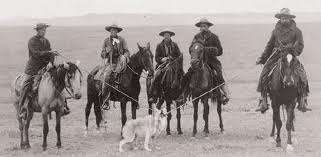
Cormac McCarthy's grandfather, Vern Kuplinksy, on the far right of this photo, took part in hunting the roving packs of mad devil wolves of El Paso, who were rumoured to be able to swallow a baby whole in one gulp as if it were a bite-sized burrito that one might find in your favourite grocer's freezer section, usually next to the 'Tater Tots and perogies. Much of the inspiration and information for The Crossing came from Vern Kuplinsky's journals and the odd notes he'd jot down on flattened strips of beef jerky while on the trail.
You wouldn't think such a serious guy like Cormac McCarthy would use the premise of a joke as the basis of this great novel, but I'm here to set you straight. He does indeed, using the old "why did the chicken cross the road," premise to set up a punchline that goes on for 426 pages, relentless in its pursuit of humour only to come up short every time, toiling in the dust and wind of the Great Plains, lapping at the muddy, roiled waters of the Rio Grande before falling, soiled and weather-beaten, on to the front porch of a Tijuana whorehouse, knife scars raised like braille across its back to be traced by the fingers of blind whores forced into selling their bodies to fund their husbands' iguana farms, the lizard skins turned into purses, wallets and stiletto heeled shoes and the reptile meat used to feed their bastard offspring that wait, eyes squinting into the dusky street, hopes and dreams smashed like a skull upon the rock of a burbling stream where even the dappled sunlight finds no joy of release or purchase upon the shimmering green leaves that shade the water beneath and that carries the blood  away into the vast, unrelenting sway and timeless tidal pull of the Atlantic. That's the kind of punchline Mr. McCarthy confronts us with and I, for one, am glad of it. Of course, in place of the chicken Mr. McCarthy uses a cowboy crossing a road to get to a chicken (the cowboy being quite hungry after crossing the Mesa Verde, one of the many dangerous crossings this cowboy will make throughout the book), but the chicken happens to be in the mouth of El Lobo Diablo of Amarillo, a wolf dog born out of the unholy matrimony of a wolf and a dachshund, its sharp teeth matched by its feral and vicious nature and a sausage-like body for easily evading capture. Long the nemesis of local Amarillo ranchers and its hunting grounds stretching as far as Arkansas on the east and Yosemite on the west with the odd jaunt into Montana to forage for gribblemeyer berries and ocelot brains, this devil's sausage of a wolf-dog could never be caught nor tamed until the cowboy, who was really more of a boy than a man or a cow, saw not just a brutish animal with a chicken in its mouth, but perhaps a friend, a pal, a buddy on the road like Bing Crosby and Bob Hope.
The author, Cormac McCarthy, stands front and center of the picture, the photo taken at a writer's conference and series of readings in Tijuana, hoping to boost sales of books and call attention to literary arts funding. Not even a sombrero can wipe the sombre expression from his face and it's this kind of solemnity that makes him such a foreboding and intimidating figure in the world of arts and letters, not to mention he can crush punctuation under the heel of his cowboy boot just like he's squishing silverfish into dust.
The young cowboy's name is Emmett Gristle, and he leaves the family ranch after a falling out with his father over his calf-roping technique that his father, Clifton, finds unorthodox, but really he's just jealous because young Emmett can rope twice as many calves as him in half the time and that's including bathroom and beef jerky breaks. His technique includes not only supple lasso dexterity but also hypnotism, remedial cud chewing and sequin-studded chaps. Father and son turn to fisticuffs to settle their differences, Emmett suffering a black eye and Clifton enduring a ruptured spleen, which puts a damper on his participation in the annual El Paso refried bean eating competition, and Emmett sets off across the badlands full of piss, vinegar, rattlesnake spit and refried bean gas. That's when he encounters El Lobo Diablo, the dachshund devil-wolf of Amarillo, chewing on a chicken down on the banks of dry river bed and Emmett's hunger, knowing no bounds and his stomach rumbling like thunderhead clouds looming on the horizon, forces Emmett to befriend this beast and share in its poultry and any friendship a shared meal may bring.
In an earlier image of the author, his sombre expression is just as evident as is the sombrero upon his head, so apparently he liked and still continues to enjoy wearing this type of hat. No stranger to the sombrero, he's also quite at home with fence posts and foliage that can hide all manner of malevolent beings, but Mr. McCarthy stands, or in this case sits, steadfast, calm and unperturbed about any dangers that may lay ahead or behind in the trees. The mustache, of course, is a youthful affectation, when Mr. McCarthy was still frequenting the dance-halls for female company, and it has since been replaced with deep lines upon his face that accentuate his wisdom, grace and fondness for Canadian rye whiskey, pork rinds and hard boiled eggs, a diet that's been known to put hair on your chest that will wave in the wind like wheat on the Prairies and grow thicker than the coat on a winter grizzly.
Well, I don't have to tell you that the two fast become friends, or maybe I do have to tell you because you haven't read the book but I have so heed my words and if you have any doubts, keep them under your hat, or sombrero in this case (by the way, a sombrero holds many more doubts than say, a fedora or bowler and is highly recommended if you're a Doubting Thomas and on that note, Doubting Thomas, or Thomas the Apostle, from the bible and father of Peeping Tom, besides being famous for doubting Jesus' resurrection until the other apostles ganged up on him and thumped him soundly with their sandals until his hair shirt was covered in blood and frankincense soot, was also known as the apostle who crossed vast tracts of land spreading the teachings of his pal and fair weather savior, Jesus, or as his friends called him after a few drinks, Jimbo, delivering the good word from India to Greenland where he got into a fight with a walrus after too many shots of aquavit, and had the tusk scars to prove it and so, one can deduce, that there is a correlation between Doubting Thomas and young Emmett Gristle, utilizing the crossing theme as a metaphor for a spiritual journey although one battles a walrus and the other must wrestle a chicken from the jaws of a dachshund devil wolf, but the results are the same. Emmett and El Lobo Diablo set off across the mesa, scrabbling through the hardscrabble, pining through the scrub pines, dry mesquite and sage scratching at their capillaries and legs and eyes.
In this painting by famed artist, Mitch Clorbisol, Doubting Thomas compares his walrus tusk scars with Jesus's (Jimbo's) crucifixion wounds while the apostles, John and Ed, look on. As you can see by Ed's red nose, he'd been hitting the sauce pretty hard since Jimbo's cross hanging, which is yet another cross in the whole crossing motif that riddles this novel like bullet holes in the body of an assassinated mafioso.
Just let me make one quick aside here and say, because I base my reviews not only on the depth and breadth of the content of a book but also its silverfish killing capabilities (the New York Times along with other reputable book review pages should take a tip from me and adopt this reviewing technique I believe, because where would War and Peace be if it were just a literary endeavour instead of also a lethal killing machine and Proust's A Remembrance of Things Past, well, it would simply be a remembrance of things half-assed and crass if it hadn't proved to be such an effective silverfish crushing tool, and in numerous volumes to boot), that Mr. McCarthy creates some very muscular, very manly prose and in doing so, impels the reader to take matters into their own hands and smote the vermin beneath their feet. Never have I felt so much a man as when, brandishing my copy of The Crossing, I wiped out entire silverfish families with not a pang of conscience or any sense of moral recompense. Hats off to Mr. McCarthy, whether it be ten-gallon or sombrero, for invigorating this reader, for one, into reaffirming his masculine self to the point that I almost stood up to my landlady, Mrs. Grabowsky, when she told me to get my galoshes out of the hallway before, and I quote, she "shoved them so far up my ass my prostate could take a walk in the rain without getting wet." I say almost because she had that crazy glint in her eye (the one without the cataract), and though I believe I could take her in a fight, I also think she might manage one galosh up my behind, which, considering their formidable rubbers soles, is a thought I don't relish, especially during the extraction process.
Here's a photo of the famous, fighting Rubber Boot Ass Extraction Brigade, sometimes referred to as the Vulcanized Rubber Rectal Retrieval Team. Highly trained in secret boot camps scattered throughout the Arctic Circle, this would be the fate I'd be facing if my landlady, Mrs. Grabowsky, had her way with my galoshes, the strength of three gin and tonics behind her flabby-armed efforts and nicotine-clouded aim.
Now, back to the novel. One might ask, if say, you were sitting down with Mr. McCarthy over blood sausage and rice pudding (his good friend and former amateur astronaut and rubber tree tapper, Blythe Crimpton, has said these are two of Mr. McCarthy's favourite foods), which crossing was he expressly alluding to. Because this book is rife with crossings. Railway crossings, pedestrian crossings, crossed wires, crossed connections, star-crossed lovers, hot cross buns, crossed eyes, crossed legs, crossed fingers, crossing over to the other side, crosses to bear, signs of the cross, double crossings, things that cross your mind, crosswords, dotting your i's and crossing your t's, crossing your heart and hoping to die. If I had a nickel for every crossing in this book, I'd have enough to finally purchase that stuffed mongoose I've been pining for. Either way, the crossings are not to be taken lightly as to be witnessed in this exchange between Emmett and a group of Mexican bandits just south of the Sierra Madre, as they cross paths and the bandits take a shine to El Lobo Diablo Dachshund and wish to take him back to their hacienda as a gift for their many ungrateful, one-eyed children.
"Hola. Que es donde minero lobo tejas casita?"
"No," Emmett replied, standing his ground, El Lobo Diablo at his side. "I do not know where your mother's mustache is."
"Es una loba. Es una loba. Que paso con la Americano la perra como veras. No?"
"I'm sorry. I stand corrected. Your father's mustache. No, I do not know where your father's mustache has gone."
"Es minero con conchita dos lindo firmado pollo por favor?"
"The wolf and the chicken shall never mate," Emmett countered, reaching for his buck knife. The clouds scudded before the wan sun, its light a wash of sickly permanence drunk through the pores of the skin until all felt to wither and die inside, alluvial, muck-raked, predefined as if through the strange alchemy between the sun, sky and arid earth that rose to the feet like death's own hand, a shoe horn of cow's bone in its grip and a shoe that just would not fit the blistered sole at the end of your leg. How many more crossings before the rutted road carried too deep the passage and migration of souls until no load carried nor burden borne could be shorn like so many sheep flummoxed in the fields and bear up under the weight of parched mesa and a horizon obliterated against the last heat of the day, shimmering like bacon grease in a pan that has grown as cold as death's touch. The bandits turned, rash of buckles and buckle rash clanging and chafing against flesh and stirrup and then they rode, rode back into a darkness so dark it could be misconstrued as light if they didn't bump into things like cacti, water pails, stray llamas, discarded pianos, wandering Jews and the like.
Could this be the mustache Mr. McCarthy was alluding to in the above quoted passage. In 1832, ranch hand and moonlighting bandit, Sancho Perez, awoke to find his mustache stolen from his bedside table where he kept it in an olive jar while he slept. It had been his father's mustache and his father's father's mustache and before that his father's father's mother's mustache, handed down through the family generations and the tale was told all over Mexico how Sancho wandered the pampas, cavorted with peons and prostitutes and packed pinatas and mixed pina coladas to make ends meet on his journeys, but never found the mustache again. He died a brokenhearted man. Over a century later this mustache turned up on the statue of a Muffler Man statue outside a Muncie, Indiana franchise. Its resemblance to Sancho Perez's lost mustache is uncanny and the Muffler Man has become the centre of the annual Sancho Perez Mustache Pilgrimage where all true believers of the holy powers of the transmogrification of upper lip hair gather to pay honour to their patron saint of mustaches and mufflers.
 Although Emmett and Diablo neatly avoid this scrape with the bandits using trickery, tomfoolery (second cousin to Doubting Thomas and Peeping Tom's deadbeat dad, Lester Borenstein), plus rotten poultry gas, which they smartly emit once they realize the bandits are downwind of their intestinal evacuations, there are many more scrapes they endure including scraped knees, elbows, foreheads and testicles (the Wild West could be hard on a man's groin, let alone his mind) on their epic journey across the Great Divide and not-so-great St. Louis east-side. Ironically, that's where Emmett meets the love of his life, Toots Malone. If you thought this was a boy's-only adventure yarn, think twice, or three times if you're a little slow. Because Mr. McCarthy is no slouch in the love department and he brings the smooching aspect home with the sassy and saucy saloon singer, Toots Malone, whose breasts could suckle an entire nation without withering, drooping or running dry like the country's gold rush economy and whose language could make a sailor blush and miss the spittoon. The true question is, can she conquer not only Emmett's heart, but also of that of the devil dachshund devil-wolf of Amarillo, and she does that in spades. If she were holding a poker hand, the pit bosses would be crying. The three of them set off to conquer the west but as we know, a love triangle is a difficult thing. Maybe more difficult than quantum physics, but you'd have to ask Albert Einstein about that and he's dead. Suffice to say, when everything looks rosy, everything gets messy, about as messy as trying to gut a moose with just a Bowie knife and no garbage bags to drape over your body as a blood-spray poncho.
Could this image provide the hidden inspiration for Mr. McCarthy's character, Toots Malone. The photo shows Florence Villanchez, housewife and dachshund enthusiast, who lived two doors down from Mr. McCarthy during his Amarillo days. She was well-known for her abilities in taming the most feral of sausage dogs and their hybrid and sometimes downright demonic breeds, and many a scholar has argued she could be the missing puzzle piece in "The Crossing" dachshund connection mystery. That her dachshund-training protocol involved nudity was not lost on the good citizens of the community, especially those who shared a backyard fence with her or had a view from their kitchen window because she was adamant this type of training was only possible in an outdoor setting, and for that, many Amarillo residents thanked her.
All I can say is that prose this majestic and equally despairing, prose that pin-balls between hope and a homemade noose and three-legged stool from Gorton's Hardware, waiting to be hooked up to a ceiling fan in a rattan furnished condo in Cabo San Lucas with only the wallpaper print parrots to witness your demise, is prose that will make you forget to shave for a few days and maybe even make you forget you put a meat pie in the oven and so the next day when you open the oven door and see its dessicated remains you will be reminded of how brief life can be and the many thresholds you will cross over in the brevity of your days and you will think, bravo Mr. McCarthy, bravo, and then you will thank him, maybe even get down on your hands and knees if you haven't hung yourself first, and thank Cormac McCarthy for enriching your squalid life and enlightening your feeble mind and then you'll probably get up off your hands and knees because you're thanking him, not begging or grovelling so really, thirty seconds or so is enough time, but Mr. McCarthy may ask you to stay down on all fours because he needs a horsey ride and has so many distances to cross in his pursuit of the truth in the wild, wild west that is his mind and he needs a sturdy steed to carry him across the great plains of creativity and cerebral aneurysm-induced tumbleweeds and so with a gentle neigh and a whinny you're off into the great unknown, just another crossing in the cross-walk of life where you're bound to be hit by a car before you can cross the finish line.